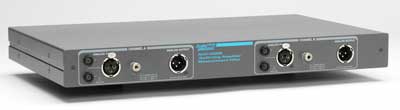
Class D amplifiers use a switching process that adds fast-rising edges at the switching frequency to the audio output signal, presenting a difficult signal for audio analysis. The solution is to precondition the signal before presentation to the analyzer using a low-pass filter that reduces the out-of-band switching components (the fast edges) while passing the audio signal intact.
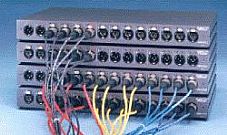
Since all Audio Precision analyzers provide two input channels, the AUX-0025 is a two-channel device. The input connectors replicate the input connectors found on analyzer inputs: XLR female and banana jacks. The output connectors are XLR male. Since loading capacitance is an issue, two short low-capacitance color-coded XLR male to XLR female cables are included for connection to the analyzer.
Preconditions output signals from Class D amplifiers
Designed for high power handling and minimal signal distortion