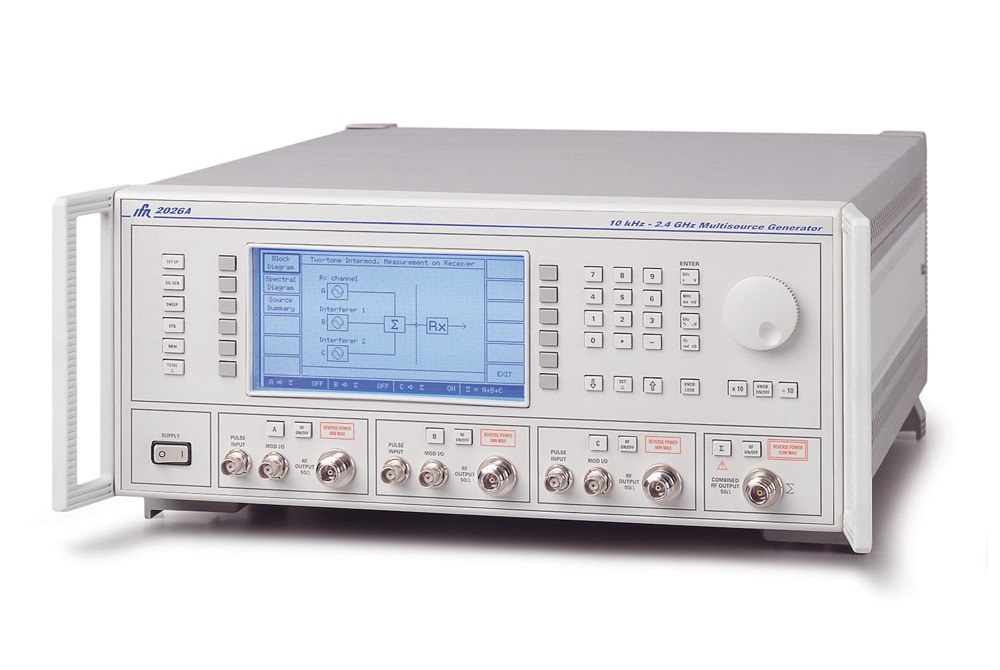
The Aeroflex 2026Q Multisource Signal Generator is designed to work with a radio test set to provide a fully integrated radio receiver test solution for cellular and PCS systems. The IFR 2026Q is a derivitive of the popular Marconi 2026 Signal Generator and is for use specifically with CDMA radio test sets.
Features and specifications of the Aeroflex 2026Q Signal Generator include:
* Two tone interference generation for AMPS/CDMA receiver testing in accordance with IS-97-A/IS-98-A
* Option for providing GSM signals for receiver and amplifier testing
* Combiner output frequency range from 800 MHz to 2.0 GHz
* Provides single calibrated point of reference for the transceiver under test
* Excellent phase noise and spectral purity (low residual FM of typically 3 Hz and typical sideband noise of -121 dBc/Hz at 20 kHz offset from 1 GHz)
The Marconi 2026Q is designed to produce a fully calibrated combined RF output containing any mix of internally generated interference signals from its two RF sources, together with a calibrated signal path for a radio test set transmit output. A return path from the transceiver back to the radio test set receiver input is also provided through the instrument. This allows a CDMA receiver to be tested for sensitivity in the presence of single or dual tone interference. The interfering signals are combined without the need for any RF switching mechanism that would otherwise affect the test result.
* Elimination of additional RF combining or signal conditioning
* High internal isolation of returned signals
* Includes two independent, fully featured RF signal generators 10 kHz to 2.4 GHz
* Very low levels of internally generated intermodulation products
* Single unit solution for CDMA interference testing
The 2026Q is configured to ensure high levels of isolation between each of the transmit and receive paths between the radio test set, the interfering signal sources and the transceiver under test. Path loss test data is supplied with each instrument for the frequency bands 865 MHz - 895 MHz, 1750 MHz - 1990 MHz. Drift influences within these bands is minimal ensuring a level accuracy of better than 0.75 dB. The frequency response across each of these bands is flat to within 0.1 dB, thus minimizing the need for additional system calibration.
Each of the two RF generators contained within 2026Q can be used independently, routed to their individual RF connectors. In this mode, each generator covers the full frequency range 10 kHz to 2.4 GHz with an output power of between -137 dBm and +24 dBm. Each source may be independently modulated either from an internal or external source(s). Modulation modes include AM, FM, PM, Pulse and 2/4 level FSK. The standard 2026 specification applies when used in this mode.
Each of the signal sources can either be routed to a separate output connector or switched to the input of an RF combiner network before being fed to the combiner output connector. The combiner routing is set up quickly and effectively using the Combiner Set Up menu. The flexibility of the signal routing allows the 2026Q to accept an external input from another signal generator, such as the 2050 Digital and Vector Generator producing CDMA modulation or a radio test set.
The two internal generators can have their frequency and level coupled . In the case of RF level this coupling can be any fixed offset enabling control of a single parameter to manifest a change in both sources. For RF frequency this coupling can be both a fixed frequency offset or a harmonically related offset and again allow simple programming and control of the instrument.
The Aeroflex 2026Q allows either of the independent RF sources to be frequency swept with user defined start, stop, and step values to reduce the amount of operator time or GPIB overhead. By enabling the coupling facility, sweeping one source will simultaneously sweep the other internal RF source to allow automated swept measurements on frequency conversion devices to be made.
Each of the RF signal generators is able to deliver up to +24 dBm at their output, making them ideal for testing components such as mixers and amplifiers.
Each signal source is capable of being independently modulated from its own fully programmable modulation source to ensure maximum flexibility. The internal modulation sources are each capable of generating sine, triangle or square wave signals.
Amplitude, frequency and phase modulated carriers can be generated from the internal modulation sources or from the independent external inputs.
The frequency modulation system provides excellent performance in the DC coupled mode with very low carrier frequency error and stability ensuring that the generator can accurately test receivers sensitive to small frequency errors.